Health Testing for Dog Breeders: OFA, Embark, and What Buyers Actually Want to See
Health testing is the single biggest trust signal serious buyers look for and the single most common gap in new breeder programs.
The pattern is consistent across breeds. A new breeder produces their first litter, prices the puppies based on what other breeders in their region are charging, and cannot understand why the inquiries are slower than expected and the buyers who do reach out keep dropping off after a couple of messages. The animals are good. The photos are decent. The website is presentable. What is missing is the health testing infrastructure that distinguishes a serious program from one that is producing puppies because the dam was in season and the stud was available.
This post is the practical guide to breeder health testing. What to test, which platforms to use, what each test costs and reveals, how to display results in a way that builds trust before the first conversation, and the specific testing protocols that distinguish a real program from a hobby. It pairs with the buyer-questions post which covers the same ground from the buyer's side, and the buyer trust post which covers presentation of records more broadly.
Who this is for: breeders setting up a testing protocol for the first time, breeders who are doing some testing but are not sure if they are doing the right tests, and breeders trying to figure out which DNA platform is worth the money. Also useful for buyers trying to evaluate what a breeder's testing should look like.
Why Health Testing Matters Operationally
The case for health testing is usually made in moral terms. Responsible breeders test. The breed deserves better. We owe it to the animals.
All of that is true. None of it gets a new breeder to actually pay for the testing. The operational case is what does.
Health testing builds buyer trust before the first conversation. The breeder who has documented, verifiable health clearances on every breeding animal, displayed clearly on their website, is selling the same animals as the breeder without testing but is selling them at a different price tier. Pet-quality puppies from health-tested parents command 30 to 60 percent higher prices than untested equivalents in most breeds. That price differential covers the testing costs many times over.
Health testing reduces the rate of post-placement disputes. The breeder who has documented OFA clearances on the parents has a clear answer when a puppy develops hip dysplasia at age four. The condition was not predictable from the parents' clearances. The contract's hereditary defect clause defines the remedy. The conversation is operational rather than confrontational.
Health testing protects the bloodline reputation. A breeder who produces a single high-profile health failure without documentation can damage their program for years. The same failure with full testing on the parents is recoverable because the testing demonstrates the breeder did the work and the failure was a statistical outlier rather than a predictable outcome.
Health testing is also a screening tool for the breeder's own program. The breeding animal that fails OFA at 24 months is an animal that should not be in the breeding program at all. The testing surfaces the wrong breeding stock before that stock produces a litter. Programs that test rigorously have better outcomes over time because the testing is removing problem genetics from the production pipeline.
The moral case is real. The operational case is what makes the testing happen.
The Testing Categories Every Program Needs
Health testing breaks into four categories. Different breeds have different requirements within each, but the categories apply across most programs.
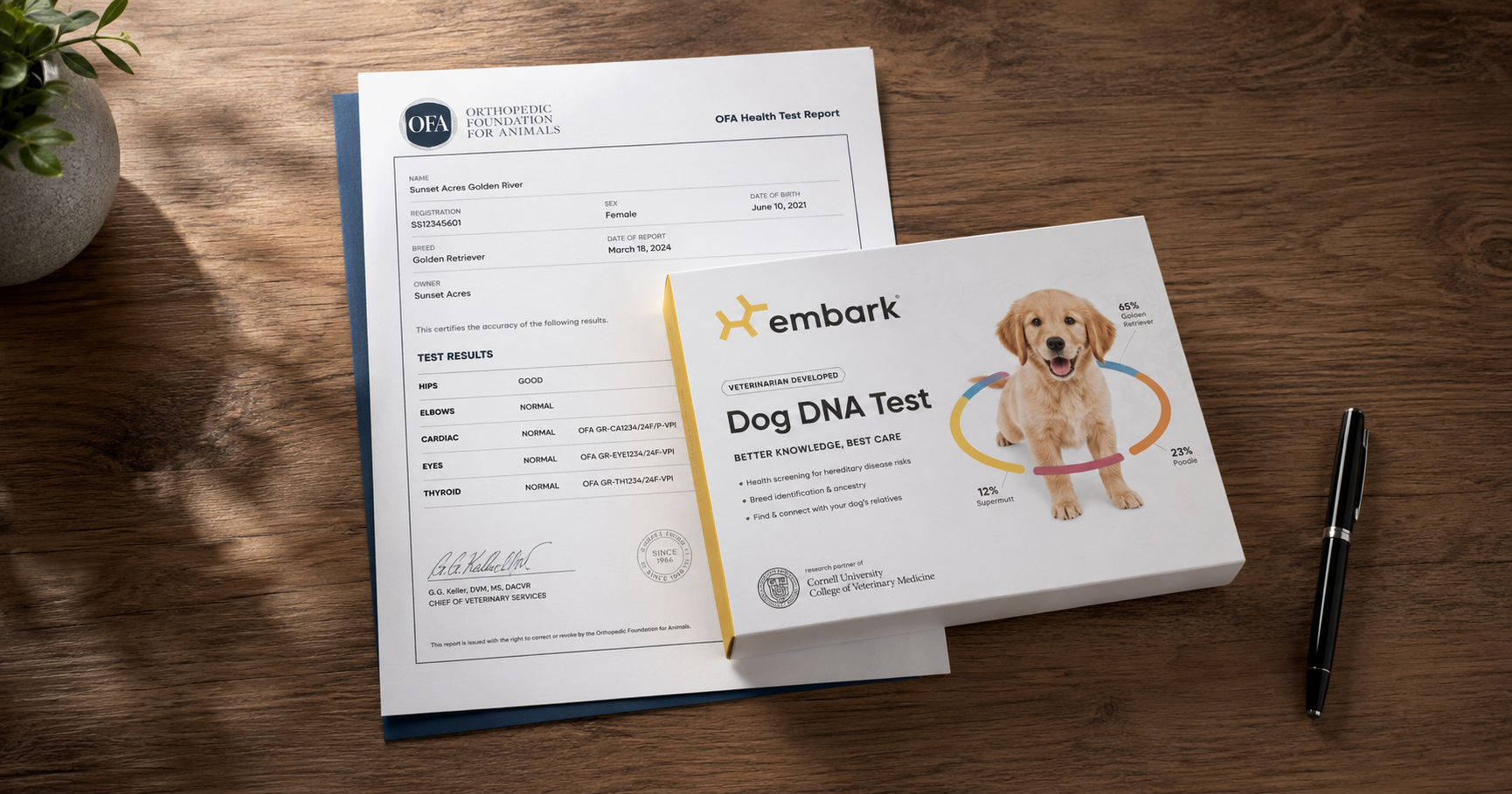
Orthopedic testing. Hip and elbow evaluations to identify dysplasia and other structural issues that affect breed health. The standard in most countries is OFA (Orthopedic Foundation for Animals) for hips and elbows. Some breeds also use PennHIP, which provides a more granular hip score using a different methodology.
OFA hips are scored as Excellent, Good, Fair, Borderline, Mild, Moderate, or Severe. Excellent and Good are the typical breeding-acceptable scores. Fair is sometimes acceptable depending on the breed and the bloodline pattern. Anything below Fair typically excludes the dog from breeding in responsible programs.
OFA elbows are scored Normal or Dysplastic. Only Normal is breeding-acceptable.
Cost: $300 to $500 for a complete hip and elbow evaluation, including the radiograph fee at your vet and the OFA submission fee.
Timing: OFA preliminary evaluations can be done at 4 months. Final certification requires the dog to be at least 24 months old. Most serious programs do prelims to identify obvious problems early, then complete final certification before the first breeding.
Eye testing. Annual eye examinations by a board-certified veterinary ophthalmologist (ACVO). Different from a routine vet eye exam. Specifically certified to identify hereditary eye conditions including progressive retinal atrophy (PRA), cataracts, and breed-specific conditions.
Results are submitted to OFA's Companion Animal Eye Registry (CAER, formerly CERF). Annual exams are required because some conditions develop later in life.
Cost: $60 to $100 per exam plus a $12 OFA submission fee.
Timing: Annual. The breeding animal should have a current eye exam (within the last 12 months) at the time of any breeding.
DNA testing. Genetic panels that identify carriers of recessive hereditary conditions specific to the breed. Different platforms offer different breed coverage and different panel depths.
The major platforms in 2026:
Embark Veterinary. The largest consumer DNA platform. Covers 250+ genetic conditions and 350+ breeds. Provides both health markers and breed identification. The Breeder Kit version (priced for breeders rather than pet owners) includes COI calculations and a breeder portal for tracking multiple dogs. Cost: $159 for the standard Breeder Kit, with bulk discounts for larger orders.
Wisdom Panel Premium. Comparable coverage to Embark with a different interface. Covers 280+ genetic conditions. Does not have a dedicated breeder portal as polished as Embark's, but the underlying testing is comparable. Cost: $129 to $179 depending on the version.
Paw Print Genetics. Specialty platform aimed primarily at breeders. Allows you to order specific breed-relevant tests rather than buying a full panel, which is more cost-effective when only a few specific conditions matter for your breed. Cost varies by panel: $49 to $250 depending on the breed-specific tests selected.
OptiGen and breed-specific labs. Some breeds have dedicated testing labs that handle conditions the consumer panels do not cover. Working with the parent breed club to identify which lab handles your breed's specific tests is part of the diligence.
For most breeders, Embark or Wisdom Panel covers 80 to 90 percent of what a typical breeding decision needs. The remaining 10 to 20 percent (breed-specific or rare conditions) may require Paw Print or a specialty lab.
Cost across the program: $130 to $250 per breeding animal, one-time, plus retesting if the animal is added to a breeding program in a different region with different breed-specific requirements.
Breed-specific testing. Conditions that are common in your specific breed that may not be covered by the standard panels. Cardiac evaluations in Cavaliers and Boxers. BAER hearing tests in Dalmatians and Australian Shepherds. Patella evaluations in toy breeds. Thyroid panels in some working breeds.
The parent breed club and the OFA breed-specific testing requirements are the right reference points. Most breed clubs publish a recommended testing protocol. Following the protocol is the baseline for serious programs. If you help run a breed club and the testing protocol still lives in a PDF on a static website, breed club software is the platform that turns it into a member-facing registry where testing results link directly to each registered animal.
Cost: $100 to $400 per test depending on the procedure. Some are once-in-a-lifetime, some require periodic retesting.
What a Real Testing Protocol Looks Like
The actual protocol that should run in a working program. Numbers are typical for a medium-sized breed; specific breeds will adjust the timing and scope.
Before the first breeding (one-time, completed by 24 months):
- OFA hip and elbow evaluation at 24 months minimum
- Initial CAER eye examination
- Full DNA panel (Embark, Wisdom Panel, or breed-specific equivalent)
- Any breed-specific tests required by the parent club (cardiac, BAER, thyroid, etc.)
- Brucellosis testing within 30 days of the planned breeding
Annually (recurring):
- CAER eye examination
- Brucellosis testing within 30 days of any planned breeding (every 6 months for active studs)
- Periodic breed-specific retesting per parent club guidelines
As the animal ages:
- Cardiac re-evaluation in breeds where age-related cardiac issues are common
- Repeat OFA on later progeny if early offspring show structural concerns
For each breeding:
- Brucellosis testing on both parties within 30 days of breeding
- Pre-breeding progesterone timing for the female
- Reproductive ultrasound at 30 days to confirm pregnancy
- X-ray at 55 to 58 days to count puppies and identify any malposition
Total annual testing cost per breeding animal:
- Year one (initial workup): $700 to $1,500
- Subsequent years (recurring testing only): $200 to $500
- Per-breeding testing (counted separately): $200 to $400
For a program with three breeding animals across multiple years, the testing budget is roughly $1,000 to $2,500 in year one and $600 to $1,500 in each subsequent year. These are real costs and they need to be priced into the program. Breeders who treat testing as an optional expense are operating at a margin that gets exposed the first time something goes wrong.
The Platform Decision: Embark vs Wisdom Panel vs Specialty Labs
The question I get most often from breeders setting up a testing protocol is which DNA platform to use. The honest answer depends on the breed and the program scale.
For most breeds, Embark Breeder Kit is the right default. The platform is the most polished, the coverage is the most comprehensive across multiple breeds, and the breeder portal makes it possible to track multiple dogs and manage results across the program. The reporting is buyer-facing, which means you can share results directly with potential buyers without additional formatting work. The COI calculator is integrated, which is useful for breed-club programs that track inbreeding coefficients.
Wisdom Panel is functionally comparable for most uses. The interface is less polished and the breeder portal is weaker, but the underlying genetic testing is rigorous. If your existing program is on Wisdom Panel and the workflow is working, switching to Embark for the marginal interface improvement is not worth the friction.
Paw Print Genetics is the right choice when only a few specific conditions matter. A breeder working with a breed where the relevant hereditary conditions are well-defined and limited (say, three specific recessives) does not need a 250-condition panel. Paw Print lets you order exactly what you need at lower per-test cost. The breeder of a breed with 30+ breed-relevant conditions is better served by Embark or Wisdom Panel because the per-test economics flip.
Specialty labs are the right choice for conditions the consumer panels do not cover. Some breed-specific tests (rare cardiac conditions, breed-specific neurological screens, particular eye conditions) are only available through specialty labs. The parent breed club is the right resource for identifying which lab handles which tests.
Most working programs end up using a combination. Embark or Wisdom Panel for the broad panel, OFA for orthopedic and eye certifications, and one or two specialty labs for breed-specific conditions the consumer platforms do not cover. The cost adds up but it is the cost of running a real program.
How to Display Health Testing on Your Website
Doing the testing is half the work. The other half is presenting the results in a way that builds buyer trust before the first conversation. Most breeders do the testing and then bury the results in a paragraph on the about page. That undersells the work and undermines its value.
The presentation that actually works:
A dedicated health testing page. Not a section on the about page. A full page on the site dedicated to your testing protocol. Title it "Health Testing" or "Our Health Protocol." Make it accessible from the main navigation.
Per-dog test results displayed publicly. Each breeding animal has its own profile page (you should already have this for SEO reasons). The profile includes a section listing every test performed, the result, the date, and a link to the public OFA registry entry where applicable. OFA results are public by default for breeders who choose to publish, and the public link is what allows buyers to verify the result independently.
Specific test names, not vague claims. "OFA Hips: Good (May 2024)" with an OFA link is a trust signal. "Health tested" without specifics is not. The serious buyers know what tests should appear and they look for them by name.
Embark or Wisdom Panel report screenshots. A clean screenshot of the full DNA panel result, with the dog's name visible and the result categories labeled, is a powerful visual trust signal. Most breeders never share these because they feel like internal documents. They should be public.
Testing protocol explanation. A short section explaining why you test what you test. Buyers researching the breed will be reading multiple breeder sites. The site that explains the testing protocol in clear language stands out. The site that lists testing without explanation stands out less.
The QR code option. Some serious programs are now generating QR codes for individual animals that link to a public-facing record with all health testing displayed. A buyer at an expo or visiting the property can scan the code on the enclosure card and see everything in seconds. This is operationally what tools like ReptiDex (for reptile breeders) and the Built By Dusty platform handle for dog breeders. The setup is more work upfront, but the trust signal it creates is hard to match with any other approach.
The Most Common Health Testing Mistakes
The patterns I see in new and intermediate programs.
Doing the testing but not displaying it. A breeder with full OFA clearances and a completed DNA panel and no public-facing display is doing the work without getting the credit for it. The buyer who would have paid more for tested parents cannot tell that the testing happened. The result is the same price tier as untested programs.
Displaying claims without verification links. "All our dogs are OFA certified" with no specific results, no dates, and no OFA registry links is a claim that buyers cannot verify. Educated buyers treat unverifiable claims as unreliable. The verification link is what converts the claim into a trust signal.
Skipping the eye exam because it is annual. The annual eye exam is the testing that breeders most often let lapse. The dog had an eye exam in 2023 and a breeding happened in 2025 without an updated exam. A buyer who notices the gap loses confidence in the program.
Testing parents but not retaining records on previous offspring. Some health testing matters more when you can show outcomes across previous litters. A breeder who can point to OFA results on dogs they produced three years ago is showing a deeper level of follow-through than a breeder with results only on the current breeding pair. This requires staying in touch with previous buyers and encouraging them to test their dogs.
Skipping breed-specific tests because they are expensive. A breed where cardiac conditions are common needs cardiac testing. A breed where BAER testing is standard needs BAER testing. Skipping the breed-specific tests because they cost money is the gap that distinguishes serious programs from those running on the consumer DNA panel alone. The parent breed club is the right reference for identifying which tests are not optional in your specific breed.
Treating Embark as a substitute for OFA. Embark and Wisdom Panel are DNA platforms that identify genetic carriers. OFA is a structural evaluation platform that confirms physical traits like hip and elbow conformation. A dog that is genetically clear of hip dysplasia markers can still develop hip dysplasia from environmental factors or polygenic effects. The platforms complement each other. Neither is a substitute for the other. Programs that skip OFA in favor of DNA-only testing are missing the structural component that OFA evaluates.
What This Means for Pricing
The health testing infrastructure has direct pricing implications.
Pet-quality puppies from fully tested parents (OFA, current eyes, full DNA panel, breed-specific testing) command 30 to 60 percent higher prices than untested equivalents in most breeds. That is the ROI on the testing investment, paid back across the litters the breeding animal produces.
Breeding-quality puppies from fully tested parents on full registration command an even higher premium because the buyer is paying for breeding access and needs to verify the genetics they are inheriting from the line.
Breeders who underprice their tested animals because the regional market is dominated by untested programs are leaving real money on the table. The buyers who pay full price for tested animals are also typically the buyers who are easier to place with, more committed long-term, and more likely to refer additional buyers. The pricing differential is not just a higher number. It is a different buyer segment.
If your testing protocol is comprehensive and your animals are still selling at the regional average price for untested programs, the issue is not the testing. It is the presentation of the testing and the positioning of your program. The post on what buyers look at before they message you covers the broader presentation case.
The Honest Cost-Benefit Analysis
Health testing costs $700 to $1,500 per breeding animal in the first year and $200 to $500 in each subsequent year, plus the per-breeding costs.
Across a five-year breeding career for a single breeding animal that produces five litters, the total testing investment is roughly $2,500 to $5,000.
Across those five litters, a breeder commanding a 30 to 60 percent premium for tested animals over the regional untested market price is generating an additional $4,000 to $15,000 in revenue per litter (depending on breed and litter size). The total premium across the breeding career is $20,000 to $75,000.
The testing pays for itself many times over. The only programs where the testing economics do not work are programs that are doing the testing and not displaying it, which is a presentation problem rather than a testing problem.
The other ROI is qualitative. Tested programs produce healthier, longer-lived dogs over time because the breeding decisions are informed by genetic data. The bloodline improves. The reputation compounds. The buyers who placed with the program become referral sources because their dogs are still alive at 12 and 14 and they remember why they paid the higher price for a placement they understood.
The breeders who treat health testing as an expense are running a different business than the breeders who treat it as an investment. The numbers above are the difference.
Get Started
If you are setting up health testing for the first time, the practical sequence:
- Identify the parent breed club and review their recommended testing protocol.
- Schedule the OFA hip and elbow evaluation with a vet experienced in OFA radiographs (the radiograph technique matters and not all vets are equally skilled).
- Schedule a CAER eye exam with an ACVO-certified ophthalmologist.
- Order an Embark Breeder Kit or Wisdom Panel test for the dog.
- Identify any breed-specific tests the parent club recommends and schedule those separately.
- Once results come in, build the per-dog profile pages on your website with the test results displayed publicly.
The protocol takes a few months to complete because OFA requires the animal to be 24 months old for final certification and the eye and DNA results take a few weeks to arrive. Plan accordingly. New breeders who try to compress the testing into a few weeks before a planned breeding usually end up rushing or skipping steps. Start the testing protocol as early as possible in the animal's life, treat the prelim and final stages as separate milestones, and build the recurring annual testing into your calendar so it does not lapse.
If your program is also dealing with the operational side (storing test results, tying them to specific animals, generating buyer-facing displays, tracking which dogs need which annual retests), that is the platform side and it is what I work on at Built By Dusty. The contracts side, including the puppy sales contract and the rest of the Breeder Contract Kit, are how the testing translates into the contractual representations that protect both the breeder and the buyer when something does eventually go wrong.
The breeders who build a real program around testing are the breeders who command pricing power, build long-term reputation, and avoid most of the disputes that consume the rest of the industry. The testing is the foundation. Everything else is built on top of it.