
Bundle & save
Want every keeper's emergency template? Get the full kit.
The Keeper's Emergency Kit includes this document and 22 more for $18.50. Lifetime updates included.
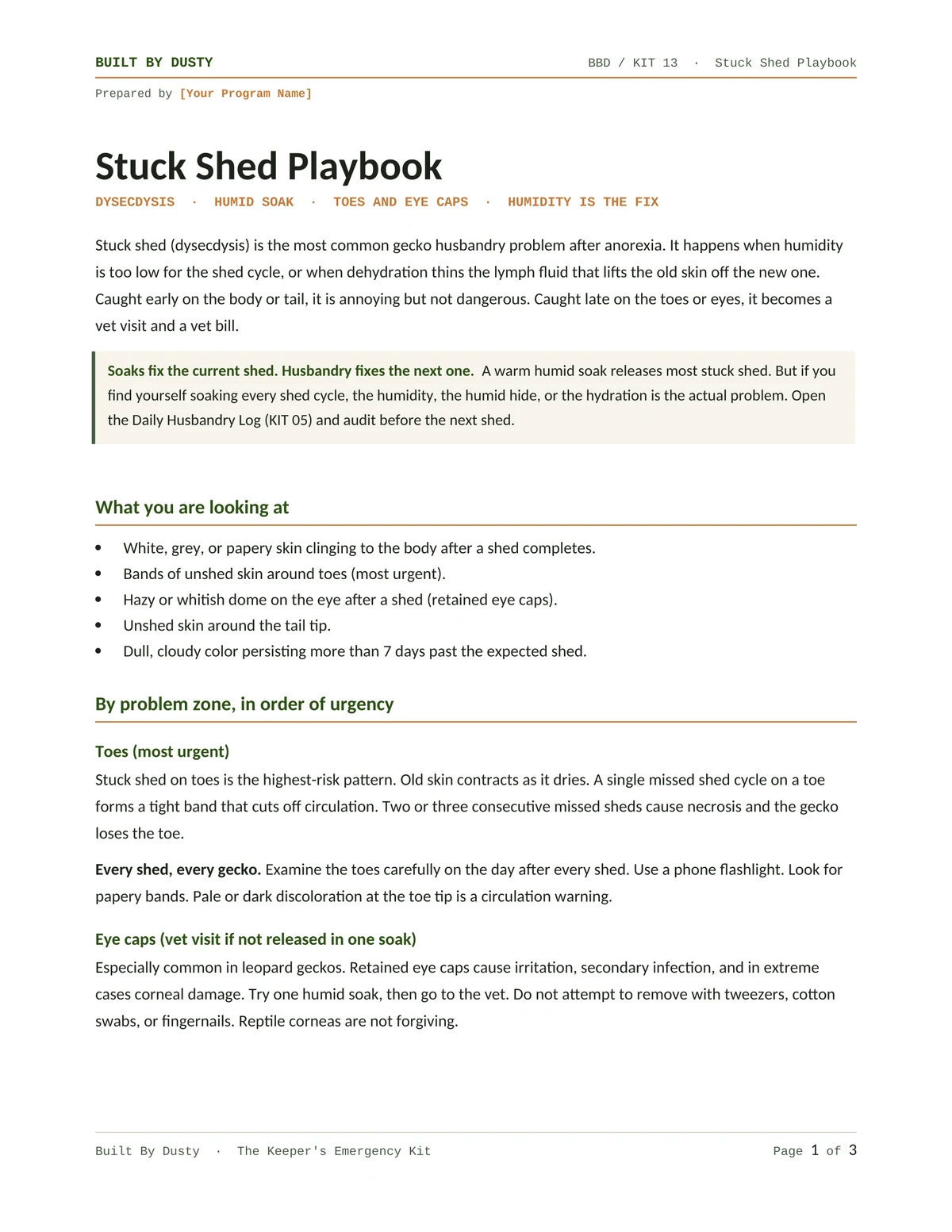
Document · Keeper's Emergency
Warm humid soak protocol, four problem zones by urgency (toes, tail tip, eye, vent), and the husbandry audit that prevents the next one. Toes are time-sensitive.
About this document
Stuck shed (dysecdysis) is the most common gecko husbandry problem after anorexia. It happens when humidity is too low for the shed cycle, or when dehydration thins the lymph fluid that lifts the old skin off the new one. Caught early on the body or tail it is annoying but not dangerous. Caught late on the toes or eyes it becomes a vet visit and a vet bill.
The Stuck Shed Playbook gives the keeper the warm humid soak protocol that resolves most stuck shed at home, names the four problem zones by urgency, and frames recurring stuck shed as a husbandry problem worth auditing rather than a recurring soak.
What the document does:
It defines what stuck shed looks like, splits the four problem zones (toes, eye caps, tail tip, body patches) by urgency, walks the warm humid soak protocol step by step, lists what not to do, sets the escalation criteria for vet-now, and provides the husbandry audit checklist to prevent the next stuck shed.
What is included:
Format and how it works:
Word version (.docx) for editing and a PDF version for printing. The playbook is written to be referenced when stuck shed appears and re-read between sheds to prevent recurrence.
Why this version is different:
Most stuck shed advice frames the warm soak as the cure. The Stuck Shed Playbook treats the soak as triage and names humidity correction as the actual fix. The four-zone urgency frame also clarifies why retained eye caps are a vet visit and why stuck shed on toes is the highest-risk pattern (constriction leads to circulation loss leads to toe loss).
Who this is for:
For gecko keepers managing an active stuck shed episode and for breeders who want every buyer to know the protocol before the first shed cycle in the new home. Pairs with the Shed Log (which makes recurring patterns legible) and the Daily Husbandry Log (which exposes the humidity gaps that drive stuck shed).
Get the playbook on its own, or open the bundle for the full kit at volume pricing.
What you get
Editable in DOCX + PDF, with lifetime updates when laws or registries change.
Bundle & save
The Keeper's Emergency Kit includes this document and 22 more for $18.50. Lifetime updates included.
Updates
You bought version 1. When a state adds a registry requirement, a new federal rule lands, or a working breeder catches something that belongs in the document, the new file shows up in your inbox. No upsell, no annual subscription, no "unlock by upgrading." The document is yours, updates included, forever.
Common questions
The contracts were drafted with an attorney and pressure-tested across multiple working programs, but they are templates — not a substitute for a lawyer for your specific state's laws. Each file ships with a clear note about that. Most breeders use them as a starting point and have a local attorney review for state-specific edits.
DOCX + PDF. The DOCX opens in Word, Google Docs, Pages, or LibreOffice. The PDF is fill-on-screen or print-and-fill. Everything is editable.
When I ship a new version of this document, the new file lands in your inbox. Laws shift. A state adds a registry requirement. A working breeder tells me something that belongs in the document. The next version goes out to everyone who bought the previous one. No upsell, no annual subscription.
14-day no-questions-asked refund. If the documentdoesn't fit your operation, you get your money back and I'd genuinely like to hear why so the next version is better.
Yes, by a wide margin if you need more than two or three documents. The Keeper's Emergency Kit bundles this and every other keeper's emergency document for $18.50.
Also useful

